Thursday, September 23, 2010

Acting Swiftly

"There were many grebes, making spreading wakes in the water as they swam, and I was counting them and wondering why they never were mentioned in the Bible. I decided that those people were not naturalists."
Ernest Hemingway writing of the Sea of Galilee in the Green Hills of Africa.
 The ability of birds to fly has always captivated the human imagination. In our dreams we soar over the landscape with the ease and freedom that by day, we envy in the birds. Vividly can I remember the days when I was a distance runner. On a good day I would glide nearly effortlessly over the countryside. I can no longer do this alas, but the joy of sprinting through the trees and the feeling of physical power was as addicting as anything I have ever experienced. I was confined to the surface of the earth however, any vertical movement I accomplished was dictated by the terrain I crossed. How must it feel to be free of such restriction? To be able to move in any direction, limited only by the speed of thought? I can only dream how it must feel. But Swifts, paragons of flight, need not dream such freedom. They live it.

Every Spring, here in northeast, the Chimney Swifts (Chaetura pelagica) return from their South American home. Briefly, from April to September, we are graced with these aerial masters. The spend nearly all their waking moments on the wing, landing only to roost or nest. They are creatures of the air, and indeed seem to be all wing. Their short, stubby tails and cigar shaped bodies, are eclipsed by long and elegantly curved wings. It is as if the Swifts fly on feathered sabers. To human eyes, which work in very complex ways with our brains, an optical illusion occurs when viewing flying Swifts. We sometimes perceive the wings acting opposite of one another, one being up and the other being down at any given moment, even though they aren't. An oddity created through their evolution and ours.

Long saber-like wings extend well passed the end of the Swift's stubby tail at roost. Note the tail feather's webbing stops short of the end of the shaft, creating "spines" that help the swift perch on vertical surfaces.
Swifts feed on the wing, drink on the wing, bathe on the wing, are believed to engage in play on the wing, and may even mate on the wing. They appear to have no ability to walk or hop on horizontal surfaces, and rarely perch on a branch. They land (or "cling" more appropriately) on vertical surfaces, and can crawl upwards or sideways. They are very social, roosting in large numbers. And according to Swift rehabilitator Jayne Amico,  they are one of the very few avian species to respond positively to being petted. Swifts inhabit our towns and cities, flying over us as we go to work, mow our lawns, go shopping, sit at an open air concert, or any of the myriad of activities that make up our earth-bound lives. Yet the average person knows little or nothing of these winged maestros. Indeed, most birders know little of them as well.

Jayne Amico holds one of the Swifts in her care.

During the breeding season they are found throughout most of the eastern United States, spilling into southern Canada. They evolved to nest and roost in vertical fractures of cliffs, caves, or the hollow carcasses of old growth trees. As mankind altered the landscape by felling the trees and building massive brick and mortar chimneys, the Swifts adapted and moved to these artificial trees, or to large open buildings. Swifts are extraordinarily social, roosting intimately in large groups.They nest as single pairs, but will sometimes tolerate non-nesters roosting in the same chimney. This has led to the erroneous belief that they nest colonially.

Chimny Swift. Photo by Jayne Amico

Within a couple of weeks of their arrival on the breeding grounds, they begin courting or pair bonding behavior. They fly in small groups of a half dozen or less, frequently in sets of three. It may be two males following a single female. It is during these "trio" flights that they display some of their most amazing flying skills, darting at high speed through trees, between buildings, or soaring high into the air. When two Swifts are flying in an apparent bonding flight, the trailing bird will sometimes snap its wings upwards and hold them stiffly still, forming a V shape. This is called "vee-ing", and it is done first by the trailing bird and then often by the the leading bird. Swifts have been observed flying very close together while vee-ing and even appear to be briefly copulating.

Swifts build their nests from small twigs grasped in their feet and broken from trees as they fly. Both birds in the pair do this. These twigs are then cemented in place at the nest site with the bird's sticky saliva, which is produced from a gland that enlarges during the nest building season.


They seem to favor the most sheltered and darkest location in a nesting structure. The eggs are laid when the nest is about half constructed, and construction continues during incubation. Construction completes before the eggs hatch. On average, it takes between two and three weeks to complete the nest.

The average clutch is about four eggs, which are white and semi-glossy.The incubation of the eggs is done by both parents and takes about 19 days. The chicks are altricial at hatching, naked and helpless. Amazingly, their feet develop quickly and they may be able to grasp the wall of their nest site as soon as one day after hatching. The chicks gain mass quickly and reach adult mass after about three weeks.


Feather tracts appear as dark spots under the pink skin at around four days and the feathers erupt through the skin at about one week. The eyes open around week two and fledging occurs at about thirty days. At around nineteen or twenty days, the nestlings leave the net and cling to the nest site wall. While clinging to the walls they spend much of their time exercising their wings. This builds up the flight muscles. Both parents feed the young. There sometimes are "helpers" that assist in the incubating of eggs, and the brooding and feeding of nestlings. It appears these helpers are young adult Swifts, or at least non-breeders.

Once fledged, the young may continue to roost with the adults or join them at communal roosts. The adults no longer feed the fledged young, who are now already masterful fliers. The number of Swifts in a roost can sometimes be very large. The following video is of the closely related Vaux's Swift (Chaetura vauxi), going to roost in Portland, Oregon, but the tornadic roosting flight behavior is the same for Chimney Swift.


These roosts grow as the nesting season ends. When the cool, stable atmosphere of beautiful Fall days come, the Swifts begin their long migration south. Little is known of their behavior on the wintering grounds, in the skies above South America. We in the northeast can only await their return the following April or May.

While they are nesting here in the northeast however, things sometimes go wrong. This is where rehabilitators such as Jayne Amico play a role. Swift nests can be dislodged by heavy rains and fall into people's homes. Or worse, they can be "swept" out by chimney sweeps cleaning chimneys. When this happens, they are sometimes taken to rehabilitators. All too often sadly, the dislodged Swifts are simply put in situations they can not possibly survive. The Swifts in Jayne's care are the lucky ones. She has mastered rearing and releasing these unfortunate individuals, or healing those that have suffered injury. It is far from an easy task, and no one should undertake it who isn't trained and immensely dedicated. I have had the good fortune to witness Jayne in action with Swifts, and I have come to admire her skill, dedication, and love for the birds she handles. I do not think I have ever witnessed the degree of professional knowledge and child-like affection that Jayne exhibits in ministering to her flock. Sorry, I couldn't resist the phrase. The following are a few pictures I took at The Mount Vernon Songbird Sanctuary last July when I visited with my daughter Janet and her friend Emily.

Nestlings in special care at the Sanctuary


Jayne feeds her Swifts in the purpose built feeding "chimney" at the Mount Vernon Songbird Sanctuary.

Four of the Swifts perched on the vertical walls of the enclosure.

Emily and Janet observe Jayne caring for her wards.
Sometimes it is necessary to hand feed individual Swifts that do not adapt quickly to the foreign process of taking food from a human.
Swifts, like many of the bird species in our world, are declining in numbers. There are few or no new chimneys being built that they can use for nesting. Additionally, many existing chimneys are being capped to keep the birds out. To my mind, many people love seeing wildlife, as long as it isn't on their property. The loss of these magnificent aerialists is deeply regrettable. In watching Swifts fly, we are able to witness what perfection evolution can achieve. What a dreary place the skies over our cities will be when they are no longer sliced by the Swift's feathered sabers.

To learn more about Swifts and what you can do to help protect them, visit ChimneySwift.org at:
http://www.chimneyswifts.org/

Monday, September 20, 2010

Rattle and Kink

"Those who contemplate the beauty of the earth find reserves of strength that will endure as long as life lasts."  Rachel Carson
Black Rat Snake (Elaphe obsoleta obsoleta)
 The heat of a mid September sun was firmly clamped on the Walden Preserve in Salem, Connecticut. It was mid day and it was quite warm for the date. I had been feeling a bit beaten down by life recently, and not without good reason. I had also been ridiculously busy. The prior weekend I had taken my daughter and her friend Emily camping on Selden Island on the Connecticut River in Lyme. In order to do that, I had rebuilt a canoe the week before, designed and built a boat rack for my pickup truck (which I finished at 12:30 am the night before the trip), organized all the gear needed, loaded all the gear and three boats in the truck, paddled all the gear to Selden Island, set up camp, cooked all the girls meals, broke camp down afterward, loaded all the gear back into the canoe, paddled the gear laden canoe upriver to the boat launch (while the girls flitted by in agile kayaks), Loaded the truck back up, drove home, and unpacked,  cleaned, and put away all the gear at home. All this after working a full work week. Admittedly I love doing things for kids, but it had been a tough week. So today, with my daughter spending the day with her friend Rachel, I knew my psychological state was low and needed an immersion in the woods. So here I was, looking for Black Rat Snakes. That was why I was here at mid day, to increase my chances of finding these inky serpents soaking up the warmth of the sun.

New England Aster (Symphyotrichum novae-angliae). One of the beauties of Walden Preserve.

I had been walking the meadows and forest of the preserve for an hour or so, and I had been looking under rocks and logs for snakes of any sort, while singing Mark Knopfler songs to myself. This is the sort of behavior that can guarantee odd looks from passersby and the suspicious attention of law enforcement officials. This endeavor allowed me time to think about my trials and tribulations and to lose them in the forest, at least temporarily. However, my log and rock flipping would prove fruitless this day, well serpent-less anyway. I did unearth numerous Red-backed Salamanders, which I had to remove before replacing the rocks and logs, to avoid turning them into ex-salamanders. So, tiring of flipping things over, and liberally covered with the fecund earth of the forest floor, I decided instead to start walking hard and fast for the exercise. It wasn’t long before I was sweating liberally as well. It was at this point that I spotted a Black Rat Snake draped across a fallen log off the side of the trail. These beautiful black snakes are usually fairly slow and approachable. So slowing to a casual walk, I approached the snake with the expectation of simply picking it up. Apparently this individual fancied itself a track star however, and shot off at a pace that took me totally by surprise. Not one to be outdone, I sprinted after it. The snake was in its element and shot down a steep slope while winding through a maze of saplings and brush. As I ran through the undergrowth after it, and by “ran” I mean stumbled clumsily, I lunged repeatedly at its fast disappearing tail. Just when I thought it was mine, it was gone. I stood there, heart pounding, breathing hard, beaten in a race through the woods by a creature which had exactly no legs. Oh the indignation of it all.

Green Darner (Anax junius) Female. A common fall migrant dragonfly hawking prey over the meadows.
Accepting inglorious defeat, I continued on. I then happened upon a colleague from work who was walking with his two sons. They were admiring the recent gnawings of beavers on the local flora. I spent a few minutes talking with them and learning about air-soft guns and ferrets from the two boys. I think every boy should have air-soft guns and ferrets. Surely nothing could ever go wrong in a household with air-soft guns and ferrets? Well time was pushing on, as it is wont to do, so I said adieu and walked on. I was heading back to the parking area when I noticed a long black stick on the path ahead. It was an odd looking stick, it looked quite like another Black Rat Snake! A few years ago, my friend Hank Golet had sent me a picture of a Black Rat Snake he found in Old Lyme, which was doing an odd defensive/camouflage posture. It can only be described as “kinked.” I personally had never seen any of the numerous Black Rat Snakes I had come across do this, till today. There was this guy on the path ahead of me, and he was “kinked.” It was a nice sized adult, right around 5 feet in length, maybe an inch or two short of that.


Odd "kinked" behavior of Black Rat Snake.


Prepared for another possible dash, I approached the snake. This one however, remained motionless in its odd posture. I reached down, and as my hand approached the snake, the tail started to rattle among the leaf litter. This is another defensive bluff that several snakes perform, attempting to appear a Rattlesnake. Being just bright enough to know the difference, I was undeterred. I picked up the long ribbon of muscle that was the snake and felt its strength as it wrapped itself around my hand. The serpent made no attempt to bite me. Indeed, as I have experienced with Black Rat Snakes before, holding the snake’s head required just the lightest pressure. This species is generally quite easy and pleasant to handle. If I had relaxed my grip on a Northern Water Snake this much I would have been bitten in a heart-beat. Less than a heart-beat, actually. I draped the snake over my arm and as it wrapped itself tightly around my forearm, I felt the tail tip continue to vibrate against my skin, an odd feeling indeed.

The Black Rat Snake often offers little resistance to being held. My grip is very light. Try this relaxed soft touch with a Northern Water Snake and it will hurt your feelings!
The snake was still doing the false rattle with its tail while it was on my arm.
 The snake’s black tongue flicked in and out rapidly as it assessed its predicament. Contrary to popular belief, a snake’s tongue does not detect smells. The tongue is used to drag minute airborne particles to an organ in the roof of the snake’s mouth, called a “vomeronasal” organ, or "Jacobson's organ." This organ does the “smelling” and the tongue simply acts to bring the olfactory evidence to it. Much like how mammal’s use lungs to drag air to their olfactory organs.

Gathering data on its environment. The snakes tongue drags air particles to an organ in the roof of its mouth.
The scales around the snake's mouth have evolved to allow at least partial extension of the tongue without having to open the mouth.

I took a few minutes to photograph this denizen of the southern New England woodlands, and to appreciate its simple yet elegant beauty. I never tire of the silken feel of a large snake's skin. When I released it, it moved purposely, but not hurriedly, off into a trail side bush. It showed none of the speed of the previous snake that had left me in its dust. I wonder if that one has some Black Racer in it? I'd feel better if that were true!

Freedom. The Black Rat Snake heads for the hills.

It was time to head home. I had solved none of my worldly problems. But I was refreshed by my time in the woods. Feeling the snake constrict on my arm was like feeling the handshake of an old and dear friend. And of course, I now knew more about air-soft guns and ferrets. I wonder which of these I should get first?


To learn which snakes are present in southern New England, and some salient facts, download the Connecticut DEP publication "Snakes in Connecticut," at:
http://www.ct.gov/dep/lib/dep/wildlife/pdf_files/nongame/snkwebview.pdf

Wednesday, August 18, 2010

Pinched, Bitten, and Smeared

"I love fools' experiments. I am always making them." -Charles Darwin
"Uh, Dad, I thought you said they wouldn't bite?" "Ya, they try once in a while, but it doesn't amount to much." That was my reply to my daughter's question about whether the Northern Ring-necked Snake she was holding would bite. I was a few yards away turning stones over in Pachaug State Forest in Voluntown, Connecticut, looking for more snakes. I had found a Ring-necked Snake, and my daughter Janet and her friend Matt had been holding it and photographing it while I looked for more. "Well this one is doing a pretty good job of biting!" was her reply to my assurance not to worry. I stood up and turned around to see. Sure enough, that little so-and-so was doing his species proud.

Ring-necked Snake biting Janet's Hand
"Well don't worry about it. It won't even leave a mark." This was placating I know. Actually it did leave a mark, and it bit Matt as well. Son of a gun. It didn't bite me, and I caught it. You'd think justice would have been served and it would have taken revenge on the guy who caught it. Oh well, life is seldom fair.

Northern Ring-necked Snake (Diadophis punctatus edwardsii)
Matt holds a Ring-necked Snake.
It was a rainy Monday in August. Matt, Janet and I, were out looking for snakes and whatever else we could turn up. Matt loves snakes. And frogs. And Salamanders. And Lizards. Just to mention a few critters. Well so do I. Janet is game for almost anything. She may not get the thrill Matt and I get from finding snakes but she enjoys the woods and whatever it has to offer. Today we were getting wet and muddy while we explored, and we were getting smellier by the snake. Many snakes excrete a nasty smelling musk which they smear on an attacker, or a 12 year old, or a 51 year old who thinks he's 12. They also smear other unpleasant things on you as well, use your imagination, you'll get there. I know. Pretty disgusting. If you were picked up by a creature hundreds of times your size, you would do something similar. I know I would.

Why they are called Ring-necked Snake is pretty apparent.

This is a beautiful animal, the Northern Ring-necked Snake. Growing to only about 14 inches on average, the record length is about double that, 28 inches. They are usually found under rocks, logs, or leaf litter. It is easy to see why they are so named, a beautiful cream colored ring crosses the snake's neck dorsally. The belly is a rich yellow with a hint of orange. They usually don't bite people. Usually. These gorgeous little snakes eat salamanders, small frogs, other snakes, or even earthworms. Today both Janet and Matt would leave this snake with little bite marks on their hands. I'm pretty sure they felt they were little badges of courage actually. I was not bitten, did I mention that?

Matt with Garter Snake and Janet with Ring-necked Snake. Okay the Ring-necked is still attached by the mouth to Janet's hand. So it is sort of holding her actually.
My turning over rocks soon resulted in finding a small Eastern Garter Snake. This is certainly the most familiar snake to people in the northeast. They are the snake everyone finds in their yard at some point. I'm being judgmental here but I don't find them as attractive as the Ring-necked Snake. Still they are a snake, and therefore they are beautiful to me, and Matt. Janet was interested but not as impressed admittedly. Garter Snakes don't really bite either. They certainly can put on an impressively aggressive defensive act however. When they do bite, which happens sometimes admittedly, they can hang on tenaciously, like that Ring-necked Snake that was still attached to Janet's hand. I realized my credibility was running a bit low on this point, but Matt did not hesitate to take the snake from me.

Eastern Garter Snake (Thamnophis sirtalis sirtalis)
Eastern Garter Snakes are very common in many habitats. They grow to about two feet but have been found as long as 49 inches. The ones we found in Pachaug were small. They eat almost anything smaller than themselves but prefer mostly aquatic stuff, salamanders (I know! Salamanders just have it tough out there), frogs, and small fish. The second Garter Snake I found was about to shed its skin. When a snake sheds its skin it also sheds the specially adapted scales that cover its eyes. These scales turn a milky blue as the snake approaches shedding, or molting. If you find a snakeskin, look at the head, you'll see these eye scales are present on the shed snakeskin rather than holes where the eyes are. The photo below clearly shows these milky eye scales on this soon to shed snake.

The eye scale turns a milky blue prior to the snake shedding its skin.
The rain had pretty much stopped by now. Matt, Janet, and I decided to move on and explore other spots in the forest. We stopped at a forest stream with a large pool behind a man made dike. We poked around to see what we could find. One of the first things we turned up was a Crayfish. I don't know a great deal about Crayfish I must admit. There are about 350 to 400 species in the United States. Many are endangered due to habitat loss or degradation. They are also preyed upon by many species such as otters, raccoons, turtles, fishes, Rails, Herons, and of course, man. I scooped this one up using my bug net. The kids had to have the little guy pinch a stick (see the photo), but of course I had to have it pinch me. It grabbed my offered finger and hung on with amazing strength. I did want to have the kids see it didn't really hurt. I didn't, really. However, I think my "It won't... " credibility was still weak with the kids at that point.

Crayfish with stick supplied by Matt and Janet
Matt and Janet examine a Bull Frog
Matt quickly spotted something else in the water. He asked me what it was and I told him it was a dragonfly larva. I reached in and scooped it into my hand to show them. Specifically, it was a larva of the family Aeshnidae, or the Darners. These are the largest and fastest of the dragonflies in the northeast. The name "Darner" comes from the erroneous beliefs of people based on the long abdomen of the dragonfly and the way it lays eggs by pushing them into aquatic vegetation or rotten logs. Many misconceptions exist about these wonderful insects. They do NOT sting. They do NOT sew your mouth or eyes shut (for goodness sake!) They do NOT land on you and then bite. Okay they do bite if you hold one just right so it can get a bit of your finger right up against its mouth parts, but the bite does not hurt. I have let the largest of these bite me, the Swamp Darner, and while impressive in strength for such a light weight, it didn't hurt. The larvae of dragonflys are impressive little aquatic predators with large eyes and large mouth parts. This family's larvae stalk their underwater prey, using their large eyes and mouth parts, while many other dragonfly species larvae lie in camouflaged wait to ambush prey. When a dragonfly is ready to emerge and begin its flying stage, the larva will crawl out of the water on a rock or log and the adult will break out slowly, much like a butterfly. The dried larval skins left behind, or exuviae, can be found near the water's surface on vegetation, logs, rocks, or concrete culverts.

Aeshidae, or "Darner" Dragonfly Larva
Adult Aeshnidae. This is a female Lance-tipped Darner. It is possible that the above Larva is that of a Fawn Darner however, based on habitat and the presence of adult Fawn Darners egg-laying nearby.
The day was getting on, and Matt had to be back in time for a birthday party for his mom and sister. While we had time, I wanted to look for more snakes before Matt needed to be home, so we moved on. We next tried a couple of spots looking for Eastern Ribbon Snakes or Northern Water Snakes. I had seen an Eastern Ribbon Snake at one nearby location a couple days before, but it had eluded my capture. We looked today to no avail, but we did manage to find Northern Water Snakes.

Northern Water Snake (Nerodia sipedon sipedon)
Northern Water Snakes are frequently called "Water Moccasins" or Copperheads, by the uninformed, and are then pointlessly slaughtered. They are not Water Moccasins or Cottonmouths. They are non-venomous. They do have brilliantly white mouth linings and are vigorous biters in their own defense, but only in their own defense. This is a very common snake in Connecticut and they reach between 2 and 4 feet in length when fully grown. They will bite if handled without caution, and their mouths have a bacterial component that can cause an infection in the bite wound. This may be why the Greek name sipedon, or "infectious," has been used for this species. Northern Water Snakes will also use a convincing bluff to defend themselves. They will flatten their heads to approximate the triangular shape that is a feature of most of the venomous North American snakes. And let me tell you, when these snakes smear musk, or "whatever" on you, it really stinks! Just ask Matt and Janet. Using my bug net to reach out in the water, I snagged this little beauty.

Me holding the Northern Water Snake I caught using a bug net
Matt quickly took the snake from me after I warned that it would try and bite him if he wasn't careful. I told him his mom, Karin, would be less than happy with me if I let a Water Snake nail him! Matt is a brave young man and took the snake with no qualms. After a few pics, I put the snake back on the ground and it shot off back to the water, happy to be done with me. It had repeatedly struck at my camera while I photographed it, showing its white mouth lining. Northern Water Snakes prey mainly on frogs of the genus rana, such as Green Frogs. This is a subtly beautiful snake on its dorsal side, and a dramatically beautiful snake ventrally. The belly is patterned in reddish half moons or triangles.

Northern Water Snake
Dorsal view. Northern Water Snakes can be varied in color dorsally, this one is rather darkish. Take a good look, this is NOT a Cottonmouth or Copperhead! It is non-venomous but it is a "biter."
Trying to make you think it is venomous, a Northern Water Snake flattens its head. This is a defensive bluff however.
The beauty of the Northern Water Snake's belly
Having been pinched (me), bitten (Matt and Janet), and smeared (all of us), we called it a day. Dirty, wet, and smelly, we all headed off for a bite of our own. It had been a fun day despite the rainy start. The kids and I had found some pretty cool critters during our time in the forest. I love being able to share with children my love of the natural world, and Matt and Janet had clearly enjoyed themselves. I look forward to the next time I can be pinched, or bitten, or smeared! You should give it a shot too, it won't hurt. Well not too badly at least... it is worth it... really!

Sunday, August 15, 2010

Walk the Dark Sky

The Great Man is He Who Does Not Lose His Child's-Heart. - Mencius
One dollar. The fee for parking at Lowe's Store and hiking Lowe's path. When Lowe's Path  was first built in the 1870s, a nominal fee was charged for hikers who wanted to use it to ascend Mount Adams in the Presidential range of the White Mountains. Over 130 years later, on June 25th of 2010, I paid a nominal fee so my young friend Mark and I could do just that.

Starting Lowe's Path to Mount Adams
Hiking above treeline in the Presidentials has its risks
Mark and I have had bad luck on weather forecasts on our trips. So far, nearly every trip we planned saw a change in the forecast for the worse at the last minute. This trip had been the same. Our original plan had been to hike up to Gray Knob Cabin and spend the night and then climb Mount Adams and Mount Madison the following day. Now, with the morrow's forecast looking damp and in the clouds, we decided to climb the peaks this afternoon and evening. It would mean Mark's first night hike in the White Mountains.

Mark at the Trail Head
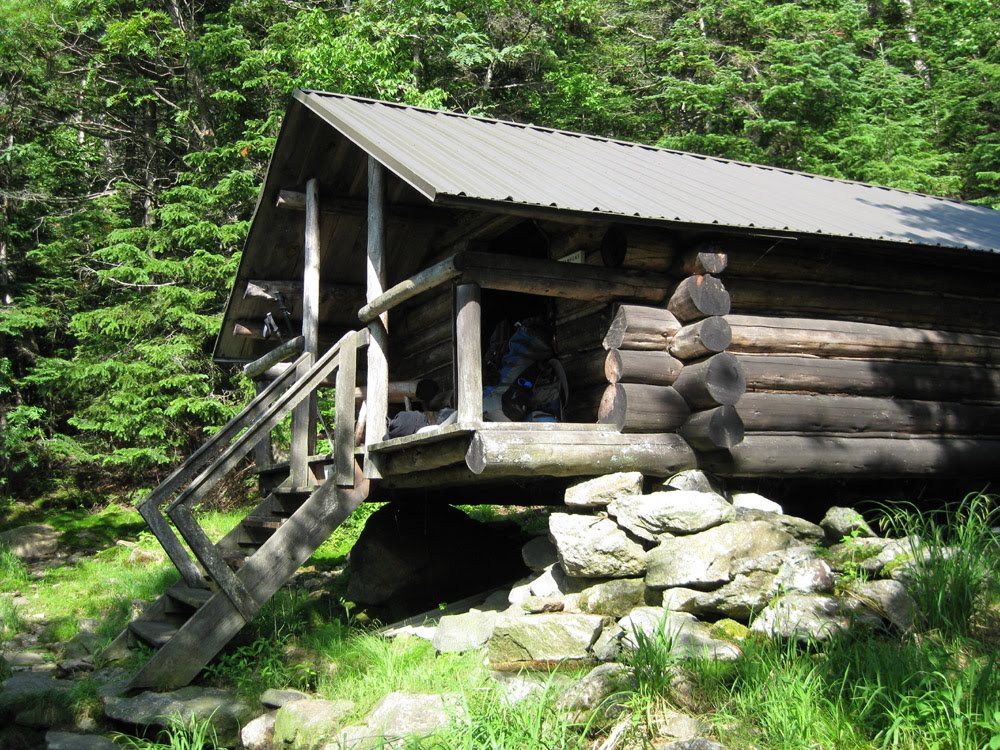
Lowe's Path starts in the Town of Randolph, New Hampshire, which lies on the north side of the Presidentials. Most of the trails leading up these northern slopes are maintained by the venerable and respected Randolph Mountain Club (RMC). This organization also operates and maintains several mountain shelters with colorful and history laden names. These shelters include "The Log Cabin," "The Perch," "Crag Camp," and "Gray Knob." Lowe's Path would take us past two of these, The Log Cabin and Gray Knob. We would be spending the night at Gray Knob after our hike.

The trip up started hot and buggy
It didn't take us long to realize the lower section of Lowe's Path was going to be hot and buggy this day. Everyone has heard of "Black Flies." Here in Connecticut we refer to them as "Gnats." Actually, Black Flies, as I understand it, is an appellation used for a number of Gnat species. Regardless of taxonomy, these little creatures are evil. Okay they're not evil, that's anthropomorphizing I admit. They just seem evil. They plagued Mark and me as we trudged up the lower slopes in the dank still air of a hot June day. I knew once we broke above treeline we would have a deliciously cool breeze, but till then we would be sweating buckets and feeding swarms of small black vampires. This made the lower hike less than usually pleasant, but the expectation of relief was kindled when we reached RMC's Log Cabin. Roughly two and a half miles up from the trailhead, we finally reached the Log Cabin and climbed in for a much anticipated break.

RMC's Log Cabin. Our first milestone on the hike up.
 We dropped our packs and relaxed for a bit. Mark can sleep anywhere, anytime. I envy that. While he power napped, I sat on the porch and ruminated. This was the fourth hike he and I had done together. He had impressed me on each one of those hikes. In some ways he was a better hiker than I was, but I had the advantage of experience and doggedness. It was the same the few times we had gone running together, he was undoubtedly faster than me but I could keep going longer than he could. I thought of these things on the porch of the Log Cabin, and I thought how much this young man had come to mean to me. He had become like a second son to me. His company was as enjoyable to me as the company of my own son, Ian. Well time was passing, it was already almost 5pm and we had quite a lot of hiking still to do, so I rousted Mark and we continued onward and upward.

Our first views on the way up
  Until we finally reached Gray Knob Cabin, our hike had been a long, muggy, buggy, walk upwards. Just before we reached Gray Knob the forest transitioned from mixed hardwood and spruce to mainly spruce. Gray Knob Cabin is situated at treeline on a northwest pointing spur of Mount Adams. It is run by a caretaker and hikers can stay on a first come first served basis. Hikers must bring their own food and should bring a sleeping bag. Pads and sleeping space are provided. Mark and I went inside and met the caretaker before dumping the gear we would not be taking up to the peaks. We also informed the caretaker that we would be hiking into the night and asked if it would be okay to return late. He told us it was fine but to be quiet and respectful of the other hikers who would undoubtedly be asleep then. He also looked a tad concerned about our being on the mountain in the dark. That was understandable, hiking above treeline in the dark does have its risks.


Approaching Gray Knob Cabin. Mount Jefferson is the peak behind Mark.

We stake out our sleeping spots in the loft
Having dropped our sleeping gear and food, we headed out and up. As Lowe's Path ascends the spur above Gray Knob Cabin, the cabin is lost  to view pretty much immediately and you really get the feel of being high and remote. I love that feeling, and starting upwards so late in the day meant we would have the slopes nearly to ourselves, another plus.

Starting up from Gary Knob. The cabin is just below the knob behind Mark.
Across Castle Ravine, Mount Jefferson and Castle Ridge.
The weather forecast for today had been for clear skies with clouds coming in the next day. Well the clouds were already here and looked threatening. I had hoped to hike under a nearly full moon tonight, now I was concerned about rain. Still we were prepared, and I hoped we could make the summit of Adams before dark. My original plan to also hike over to Mount Madison was looking unlikely at this point. I didn't mind getting back to Gray Knob at 10 or 11pm, but 1 or 2 am would be pushing hiking etiquette waaaaay past what the other hikers would think acceptable. So we pushed on for Adams and would have to do Madison on another day.

Approaching gloom. Looking northwest.
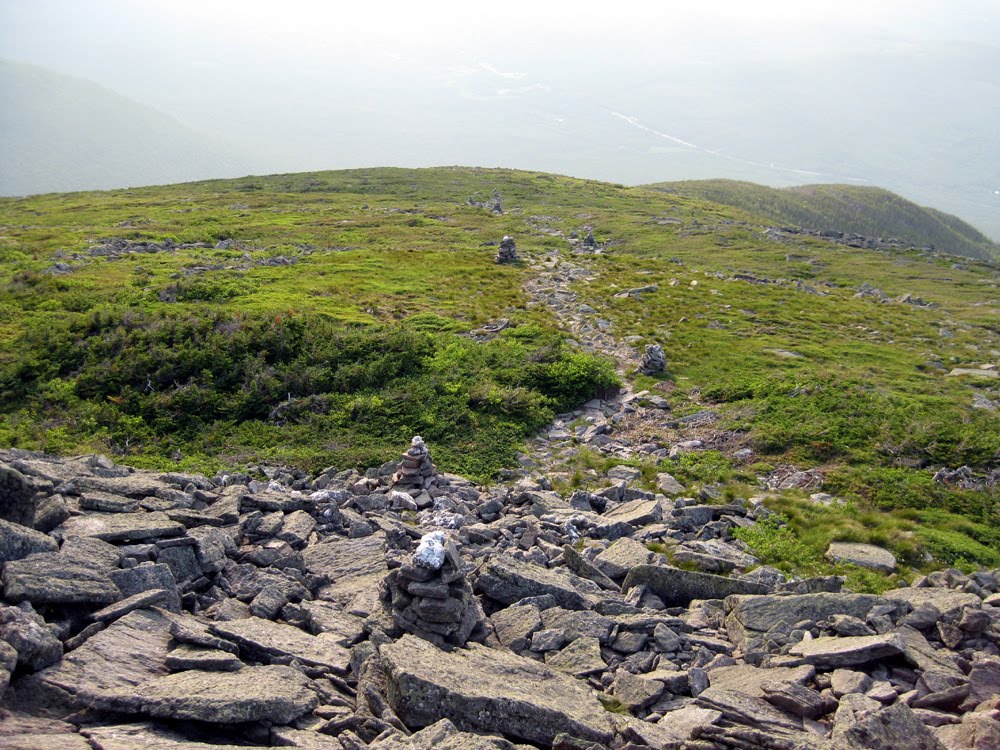
I have talked about cairns in previous posts. They are piles of stones used above treeline to mark trails and help hikers avoid getting lost in bad weather with poor visibility. Lowe's Path above treeline is also marked with cairns. The cairns here also had the added feature of large chunks of white quartz used as toppers. These white stones can actually seem to glow at night. This is an amazing thing to see, and very comforting as well since cairns can simply disappear into the gathering darkness of nightfall. Yet again do I tip my hat to the cairn builders.

Mark leans against quartz topped cairn


The trail looking back. The cairns are topped with quartz.
Lowe's Path approaching Mount Adams. Again notice the quartz topped cairns. These would appear to glow during the gloaming.
The light was failing and the clouds threatened. I really wanted to make the summit before darkness robbed Mark and me of the spectacular views afforded by Adam's summit. I don't know if there is a more spectacular view in the White Mountains than the one from that frost riven pinnacle. The trail leading there is an easy one on which to sprain or break an ankle, however, with much rock hopping to do. And the summit cone is a splintered pile of boulders that offer ample opportunity for injury, so haste must be balanced with careful foot placement.

In the distance Mount Lafayette and Franconia Ridge
Just below the summit cone of Adams,  Lowe's Path crosses the major Presidential trail called Gulfside Trail. This intersection of several trails is famously called "Thunderstorm Junction." It is not called that for no reason, this is one place you do not want to be when lightning sears the heavens. At Thunderstorm Junction, a huge cairn has been built. I call this the "Mother Cairn." We stopped at the junction for a brief rest and snack. We were on the homestretch now and looked to beat nightfall to the summit!

Standing next to the Gulfside Trail sign at Thunderstorm Junction.
Budding Thespian?
Mark and the "Mother Cairn" at Thunderstorm Junction
Break over, we headed for the summit. The summit cone is a pile of massive boulders as I said and Mark and I took slightly different paths to the top. Once there however we both marveled at the views. It was the gloaming, that time that is neither day nor night. But what light remained illuminated the glory of the Whites, particularly Mount Washington across the Great Gulf, Mount Madison to our east, and Mount Jefferson to our southwest. I can not describe the feeling of being on that pinnacle in the gathering darkness. I am not religious, but that experience was spiritual. It seemed as if we stood at the top of the world and looked down on it falling away in all directions. There is a religious society that actually considers Mount Adams to be sacred, and that some sort of divine event happened on its summit. I don't subscribe to that myself, but surely we should treat such special places as cathedrals of our natural world, and preserve them for eternity.

Mark goes for the summit of Adams
On the summit of Mount Adams. Mount Washington stands above the Great Gulf Wilderness and Mount Jefferson lies across Jefferson Ravine.
Mark and me on Adams summit
Mark looks out at Mount Madison. Below in the col is Star Lake and the AMC's Madison Spring Hut. In the distance to the left of Madison lies the town of Gorham.
Mount Washington autoroad snakes upwards on Mount Washington. Center left is Wildcat Mountain with its ski slopes visible in the failing light.
We stayed and soaked in the grandeur as long as I dared. I did not want to descend the summit cone in complete darkness. My promise to Mark's mom to bring him home safely still rang in my head. The velvet silence of night fell as we slowly made our way back to Gray Knob Cabin. I was amazed at how long we could still see as our eyes adjusted to the darkness. It was not until almost 9:30pm that we finally put headlamps on. By the time we reached the cabin it was 10pm. We had eaten a simple dinner on Adams summit but we took time to heat up some dessert before ending our day. We did this outside the cabin to avoid disturbing the hikers who had already called it a night. I had Mark call his mom to tell her we had made it safely down and then he went inside to sleep. I talked to his mom for a while and soaked in the beauty of the night with the mountain above. It had been another great day of hiking with this young friend of mine. We had walked the dark sky. Tomorrow we would go over to RMC's Crag Camp cabin to see it and say hello to the caretaker there who we had met earlier on the trail up from Randolph. After that we would head back home to Connecticut, but not before stopping at Woodstock Station for food and Pemi Pale Ale. Some things are sacred indeed.

We head back down in the dark.
Mount Adams in the night.